Seeing change slowly
Why do people fail to notice a visual change when it unfolds gradually — and can a model built from measurable stimulus properties predict which gradual changes humans miss? ChangeBlind is a browser experiment, a stimulus engine, a censoring-aware analysis pipeline and a paper, built to answer that with one command each.
A change that would be obvious in one step can vanish when spread over ten seconds
Gradual change removes the luminance and motion transient that normally summons attention. What remains is a comparison between the scene now and a limited memory of the scene before. ChangeBlind treats the resulting failures as a prediction target. Each trial shows a procedurally generated scene in which one object slowly changes colour, brightness, size, position, orientation, or fades in or out. The participant presses Space when they notice, clicks the object, and rates confidence. Non-detections are not thrown away: they are right-censored observations in a survival model.
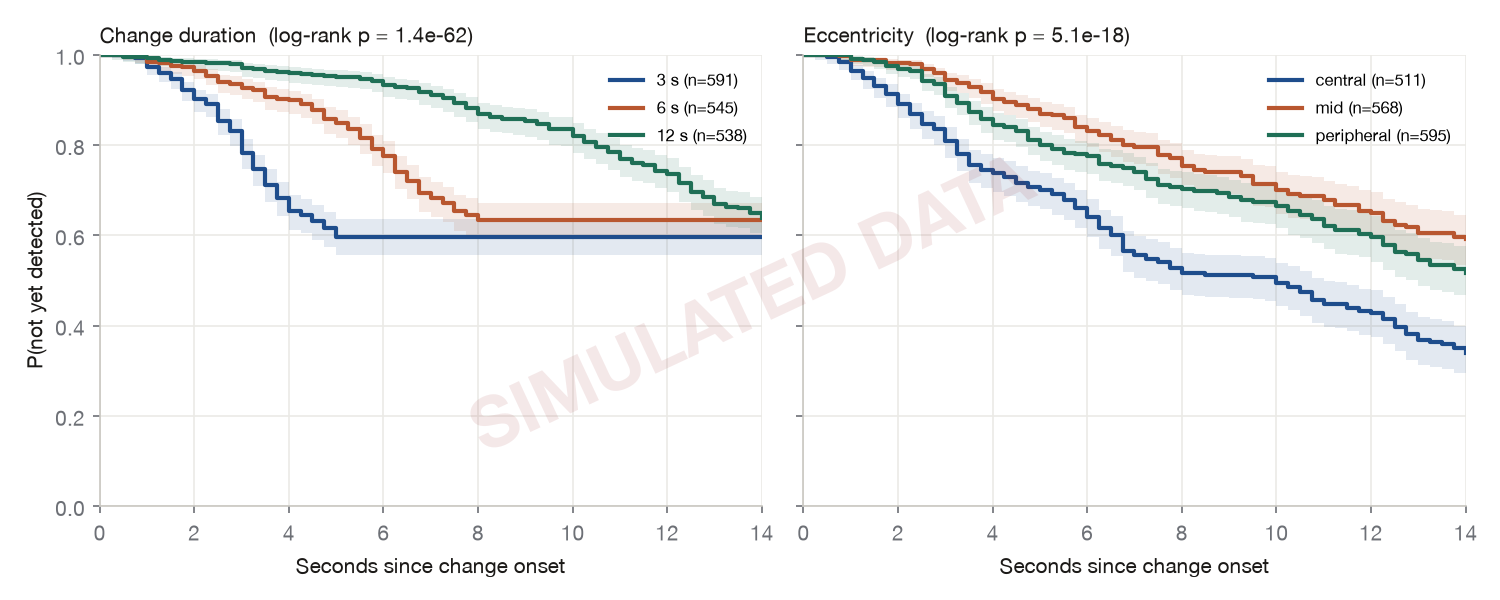
Five pre-specified hypotheses, tested so far only against a simulator
The verdicts below show that the pipeline recovers the effects the simulator was built with. They are a validation of the estimators, not evidence about human vision.
Slower changes are detected later and less often.
Cox HR per doubling of duration = 0.226 (p = 4.4e-54); log-rank across durations p = 1.4e-62.
Peripheral changes need greater magnitude.
Magnitude-at-detection AFT: +100 u eccentricity multiplies threshold magnitude by 1.131 (p = 2.5e-12).
Salient targets are detected sooner.
Cox HR per SD of spectral-residual saliency = 1.359 (p = 1.1e-11).
Semantic importance predicts detection beyond low-level saliency.
Cox HR for semantic importance (0→1) = 2.025 (p = 8.2e-13); LRT vs low-level-only logistic: χ²(1) = 16.525, p = 4.8e-05. Out-of-sample: see prediction.json.
Clutter raises detection thresholds.
Cox HR for high vs low clutter = 0.573 (p = 1.3e-10); threshold ratio = 1.240 (p = 2.2e-06).
Low-level versus semantic features
Four nested feature sets — baseline (speed, magnitude, type), + low-level vision (spectral-residual saliency, contrast, edge density, size, eccentricity, clutter), + semantic (an a-priori importance scale and animacy), combined — are compared with participant-grouped and stimulus-grouped cross-validation, so no model is scored on a person or a scene it has seen.
One command per stage
changeblind generate   # deterministic stimulus pool (seeded)
changeblind features   # CV features from the rendered frames
changeblind simulate   # synthetic participants (labelled)
changeblind analyze    # KM, Cox, AFT, mixed logistic, censoring kept
changeblind predict    # nested feature sets, grouped CV
changeblind figures    # every figure from saved results
changeblind power      # Schoenfeld + simulation power
changeblind paper      # compile the manuscript